Arrow BackBack to search results

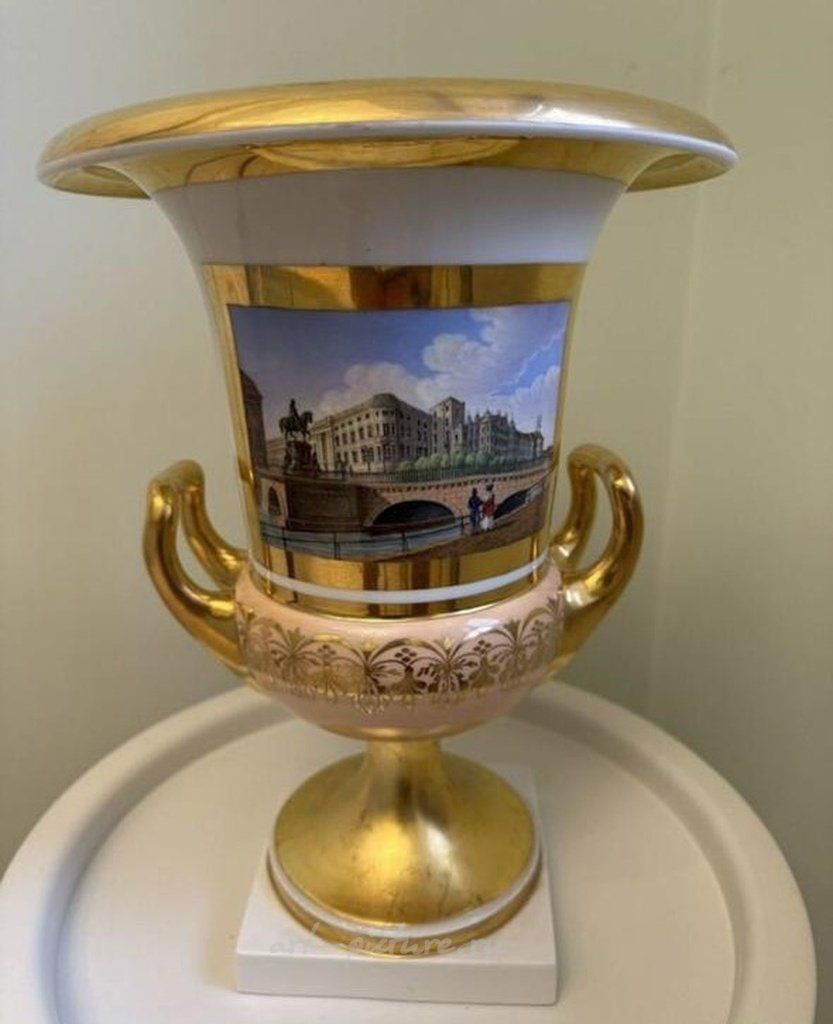
Ваза декоративная в виде кратера, в жанре «ведута» (архитектурные пейзажи) KPM

Royal Porcelain Manufacture of KRM

Description

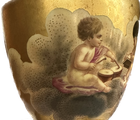
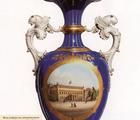
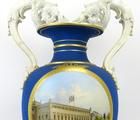
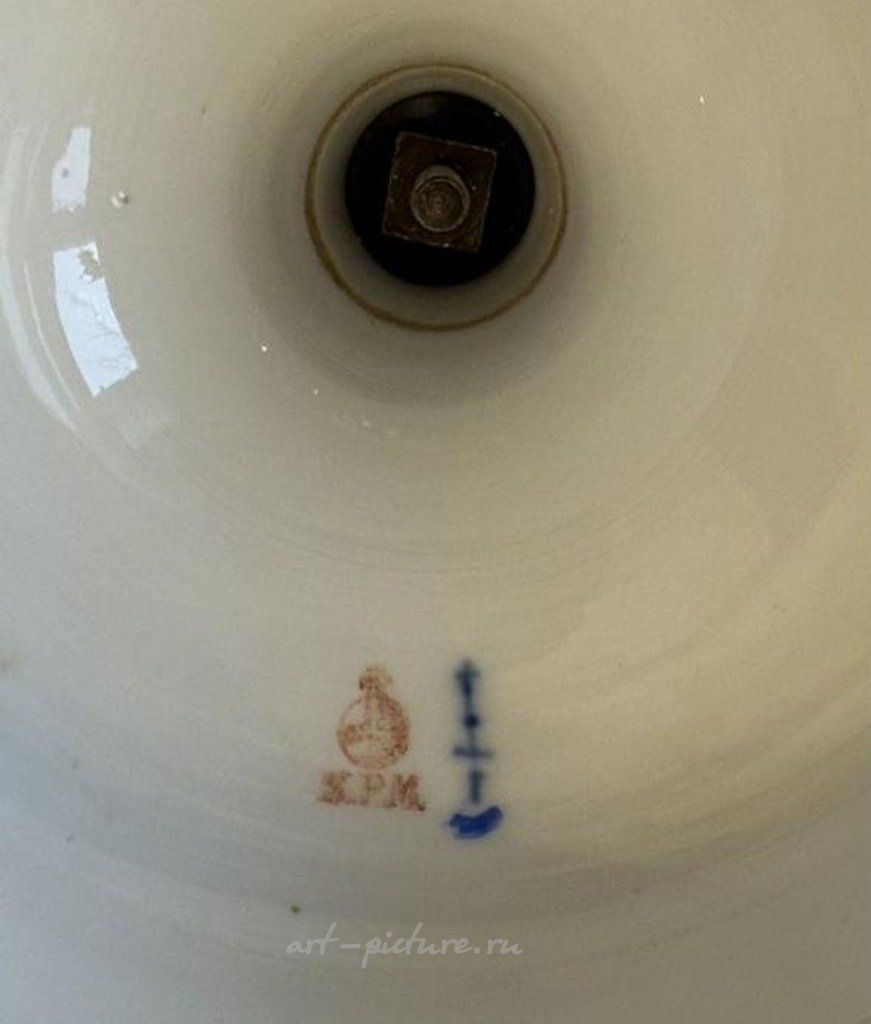
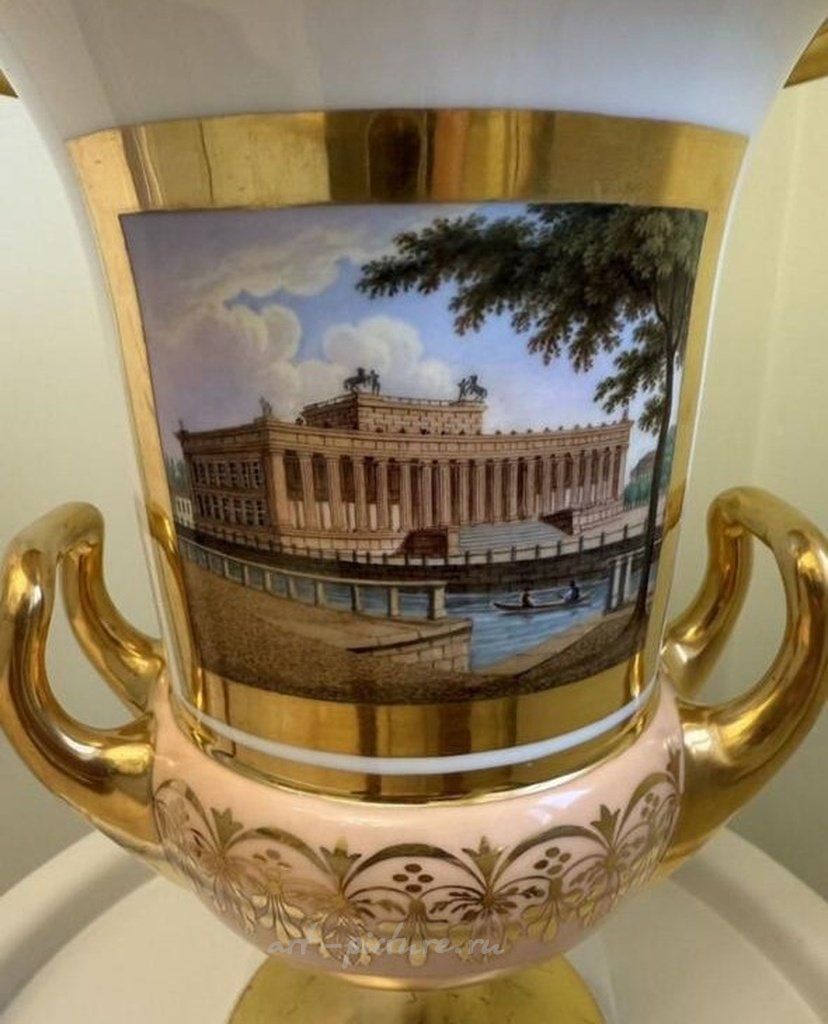
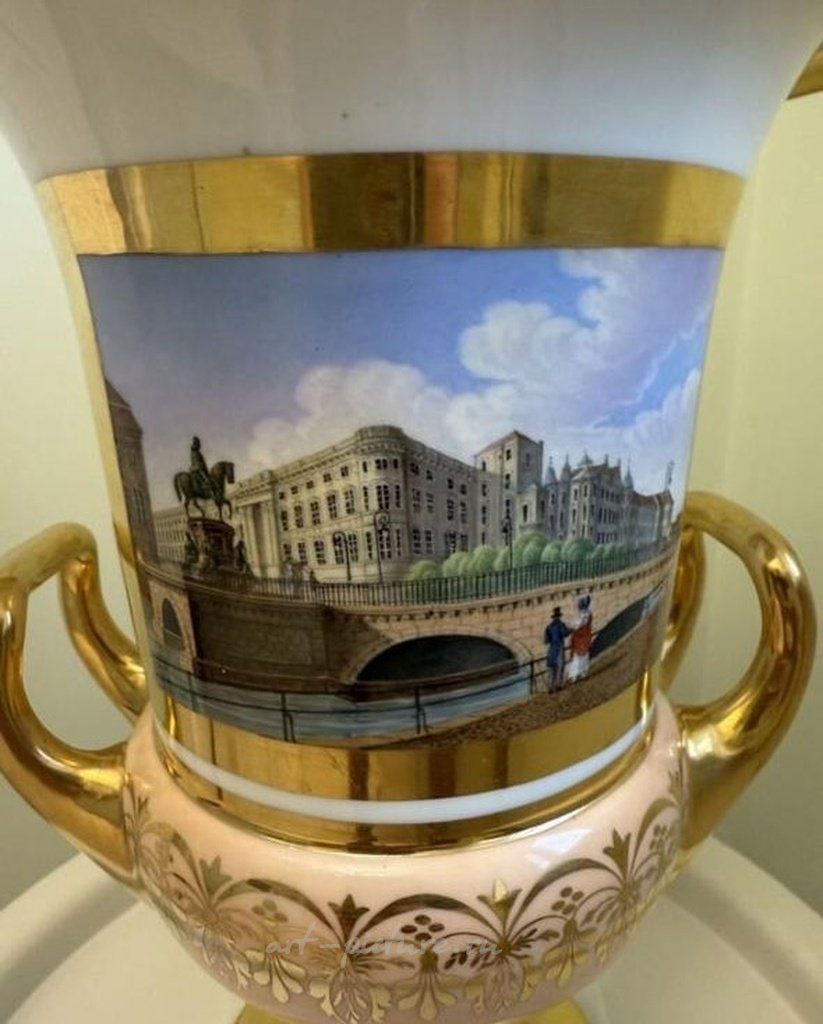
Ваза декоративная, антикизированной формы (в виде кратера), украшена с двух сторон белого тулова миниатюрной живописью в жанре «ведута» (архитектурные пейзажи). Отогнутый наружу венчик, ручки и круглая ножка - позолочены. Нижняя сферическая часть корпуса окрашена в нежный розовато-желтый цвет и декорирована росписью золотом в виде стилизованной гирлянды из пальметт. Фарфор, полихромная миниатюрная живопись (роспись), позолота, цветное крытье, роспись золотом. Размеры: общая высота - 31 см. Клейма: на внутренней части подставки ножки фирменная марка производителя подглазурного изображения синей кобальтовой краской скипетра и надглазурнь красный штамп в виде «державы» с аббревиатурой «КРМ». Германия, Королевская Фарфоровая Мануфактура в Берлине. Представленная декоративная ваза с архитектурными пейзажами на тулове относится к вещам ярко выраженного интерьерного характера, которые традиционно рассматривались как произведения декоративно-прикладного искусства, призванные подчеркнуть респектабельность домашней обстановки. Данная ваза отличается высоким уровнем художественно-технического исполнения, прекрасной сохранностью и высококачественной позолотой миниатюрной росписью. На основе визуального анализа и имеющегося клейма декоративная ваза может быть и отнесена к продукции знаменитой Берлинской Королевской Мануфактуры. Изделие изготовлено в неоклассических традициях художественного ассортимента мануфактуры втор. четв. 19 века (1830-1850 гт.), когда его основной стилистической чертой хотя и остается обращение к формам античного искусства, преобладание четких контуров, стремление к гармонии пропорций, но при этом роспись многих предметов уже несет на себе отпечаток нового стиля эпохи Историзма - бидермейера. Особенно востребованной продукцией Берлинской Королевской Мануфактуры этого времени являются декоративные вазы с миниатюрной росписью в виде архитектурных пейзажей (ведута - виды городов, отдельных зданий и городских памятников) Берлина, запечатлевшие наиболее знаменитые архитектурно-исторические памятники и городские монументы. Поверхность вазы в соответствии с европейскими традициями декорирования фарфоровых изделий рассматривалась как холст, на которую наносилась миниатюристом уменьшенная или несколько видоизмененная копия живописного произведения или гравюры. В нач. 20 века мануфактура по-прежнему выпускала изделия в стилистике классицизма и ампира (немецкий неоклассицизм кон. 19-нач. 20 в.) и общественный интерес к такому виду художественной продукции широко известной и к тому же старейшей мануфактуры в Европе, по-прежнему, был очень высоким. Данная декоративная ваза наглядно подтверждает этот факт. Так, на одной стороне тулова рассматриваемого изделия в золотом картуше-раме изображено здание Старого музея в Берлине, выполненное с некоторыми изменениями по гравюре «Старый музей» немецкого художника Ф.А. Тиле 1830 г. На другой стороне вазы - вид с городской набережной на бронзовый памятник курфюрсту Фридриху Вильгельму Берлине, являвшийся одной из самых известных достопримечательностей немецкой столицы. Обильная позолота на венчике, ручках и ноже, орнаментальная роспись золотом в нижней части вазы в совокупности с искусно выполненными архитектурно-пейзажными миниатюрами придают предмету дорогой и изысканный вид. Такие изделия великолепно украшали интерьер рабочего кабинета или гостиной в частном доме, располагались на каминной полке дорогой буржуазной квартиры, радуя глаз эстетическим совершенством предмета искусства. Не потеряли своего значения декоративные вазы немецкого производства и в наши дни, оставаясь коллекционным фарфором высокого качества и ручной работы. Данная ваза имеет антикварное, историко-художественное и культурное значение. Обзор рынка фарфора KPM Оценка рынка фарфора — довольно непростая задача. На ценообразование влияют множество факторов: ; время создания вещи, ее уникальность и редкость, качество живописи и, наконец, ее состояние. Как известно, для анализа рынка предметов многие коллекционеры опираются на каталоги торгов западных аукционов. Но оценка вещей аукционом не является абсолютным индикатором цен, поскольку аукцион - третья сторона. Большинство вещей продают и покупают, как правило, дилеры, которые более чем готовы вкладывать деньги в хорошие вещи. Зачастую вещи, купленные дилером, будут перепроданы коллекционерам по гораздо более высокой цене, такой, которую вы не найдете ни в одном каталоге! В последние годы в России заметно возрос интерес к предметам искусства. В любой стране, переживающей бурный экономический подъем, появляются весьма обеспеченные люди, которые, заработав деньги и удовлетворив все свои первичные потребности, обращают свой взор на предметы искусства. Сначала в ряды крупных покупателей антиквариата влились арабы, японцы, за ними — индусы, не заставили себя ждать и россияне. Сейчас Европа на очередной модной волне — китайской. «Новые» китайцы скупают буквально все, что может, по их мнению, вписаться в интерьеры их мини Версалей! За короткий период произошло «вымывание» с антикварного рынка колоссального числа предметов. Немаловажную роль в этом сыграли и многочисленные туристы, которые, путешествуя по странам Европы, приобретали на память чашку или тарелку с прекрасным видом, благо цены на фарфор 10-—15 лет назад были совсем другого порядка. Сейчас же даже в Вене не купить видовых чашек — не то что Венской мануфактуры, но даже «типа Вены» не осталось! Та же ситуация во Франции и в Германии, не говоря уж о России. Если в 90-е годы XX века на российском антикварном рынке предложение в разы превышало спрос, то сейчас ситуация изменилась кардинально. Пополнить коллекцию хорошим предметом — большая и очень дорогостоящая удача. С одной стороны, учитывая объемы производства, фарфор KPM — нередкий гость на антикварном рынке. С другой — редкие и уникальные вещи с высококачественной живописью встречаются нечасто и ценятся весьма высоко. Еще несколько лет назад цена на ординарные чашки составляла 300—500 евро. Сейчас на европейском рынке стоимость ординарной чашки колеблется от 1000 до 3000 евро. Цена же высокохудожественной чашки со сложной архитектоникой (с маскаронами, лепными элементами и т.д.) и превосходной живописью может варьироваться от 5000 до 15 000 евро. Нельзя не упомянуть о чашках, посвященных Тильзитскому миру 1807 года и декорированных портретами Александра I и Наполеона, а также о серии чашек, посвященных битвам при Лейпциге и Ватерлоо и декорированных портретами монархов тех стран, чьи войска принимали в них участие. До захвата Пруссии Наполеоном I также была выпущена небольшая серия парных чашек с портретами Александра I и его супруги Елизаветы Алексеевны. Эти предметы— несомненно, раритетные, и цена на них может начинаться от 25 000 евро. Для справки могу сказать, что за последние 15 лет чашки упомянутых серий на европейских аукционах не встречались. Цена на берлинские ординарные тарелки сегодня колеблется от 1000 до 2000 евро за экземпляр. Стоимость топографической тарелки может составить от 3000 до 15000 евро. Тарелки с сюжетной живописью (1790—1840 годов) могут быть оценены от 10 000 евро. А модные и популярные нынче «военные» тарелки уходят с европейских аукционов по цене от 10000 до 40 000 евро, в зависимости от их состояния и времени создания. Цена на вазы высотой около 30 см — 5000 — 10000 евро, высотой около 50 см — от 20 000 до 50 000 евро. Вазы выше 70 см могут стоить от 50000 до 150000 евро. Так, на весеннем аукционе в Берлине ваза высотой 70 см была продана за 130 000 евро. Естественно, что цены на фарфор КРМ со временем будут увеличиваться. Как и в любом бизнесе, они на антикварном рынке зависят от спроса и предложения, а поскольку спрос на фарфор устойчиво растет (это касается не только берлинского, но фарфора вообще), со временем будет все меньше предметов для удовлетворения этого спроса. Я отнюдь не призываю всех инвестировать в искусство, есть много других сфер для вложений капиталов с более быстрым и предсказуемым получением прибыли. На антикварном рынке возможна и спекуляция. Но самый лучший инвестор — серьезный коллекционер. Чтобы вкладывать деньги в фарфор, надо обладать глубокими знаниями, иметь хорошего консультанта и долгосрочные планы. Однако и это не всегда гарантирует быстрый успех, поскольку ситуация на рынке может зависеть от субъективных факторов, таких, как мода, например. Чтобы объективно оценить прибыль, должно пройти, по меньшей мере, 5—10 лет. И вполне вероятно, что тарелка KPM, купленная в 2022 году за 5000 у.е., через 10 лет вырастет в цене вдвое, а то и втрое.

Sothebys - продажа похожей вазы в 2025 году за 15 000 GBP
Lot No. 5561
650 000.00
Login

for making a purchase

WalletSale
Characteristics
# tags

Lot location LocationMoscow ( 77 )

Send a message Login

A comment

Opportunities for everyone Login

Payment by agreement

Please check the payment methods with the seller when making a purchase

Delivery by agreement

Check the delivery methods with the seller when making a purchase

Approximate prices in Russia

от 180 ₽
от 180 ₽
от 180 ₽

Additional articles

Ваза декоративная в виде кратера, в жанре «ведута» (архитектурные пейзажи) KPM

open a page

KPM Porcelain: Guide to Berlin’s Royal Porcelain Factory

KPM Porcelain: Guide to Berlin’s Royal Porcelain Factory
The ceramics galleries at the Victoria and Albert Museum in London are treasure-troves for porcelain enthusiasts. Though they are stuffed with iconic pieces like Ming vases, Dutch Delftware, and works by Sevres and Meissen, the vitrines of these galleries are also home to lesser-known gems. Indeed, very occasionally, hidden away in this cornucopia, you might come across a plaque, teacup or small figure made at the Königliche Porzellan Manufaktur, or KPM. KPM was a fundamental part of the landscape of the European decorative arts in the 19th Century, and was one of the most prolific producers of luxury porcelain in the period. It was one of the most innovative and technologically sophisticated of its time, and its output rivalled the leading factories in Europe. So why is it not more famous? What is KPM porcelain? KPM, or Königliche Porzellan Manufaktur ('Royal Porcelain Factory' in English), is Berlin’s oldest porcelain factory and Germany’s second oldest. It was founded in 1763 and continues to produce porcelain to this day. In the 18th and 19th Centuries, KPM specialised in the production of porcelain dinner services, figurines, painted plaques, vases and more. They were particularly associated with the popular mid-18th Century Rococo style, and with its replacement by the more austere Neoclassicism of the early 19th Century. Antique KPM porcelain wares from these periods are widely-collected and sought-after today. Across the 18th and 19th Centuries, KPM was one of Europe’s most consistently commercially successful ceramics enterprises. It also benefited from important financial backing: first from the Prussian crown, and later from the unified German state. It was because of its close associations with the state that the name KPM – along with Meissen – would become synonymous with German porcelain, just as with Sevres in France, Royal Worcester in England and Royal Vienna in Austria. A history of KPM porcelain KPM's present-day factory and museum near the Tiergarten, Berlin. © Manfred Brueckels via Wikimedia Commons Unlike its cousin factories at Meissen, Sevres, and Vienna, attempts to create a porcelain factory in Berlin did not get off to an auspicious start. The first two factories would both go bankrupt before finally being taken over directly by King Frederick II of Prussia in 1763. Berlin vs Meissen The real origins, however, of KPM – as with all European porcelain – lie in the Saxon town of Meissen, the first place in Europe to discover the secret to producing Chinese ‘white gold’. All later 18th Century European porcelain manufacturers were born out of an attempt to copy or steal this secret formula, known as the arcanum. Despite both Meissen and Berlin being located in modern-day Germany, the arcanum could not be shared between the two places because of the peculiarities of the country’s history. In the 18th and 19th Centuries the area we now call Germany was in fact several different countries: Berlin was the capital of the Kingdom of Prussia to the north, while the town of Meissen was part of the Electorate of Saxony further south. The two regions were rivals. By the time that the two regions unified in 1871, they both contained long-established porcelain factories: this is the reason why Germany today can boast having both KPM and Meissen as its foremost ceramics manufacturers. Early porcelain in Berlin The first attempt to found a porcelain factory in Berlin came in 1751, with a wool merchant by the name of Wilhelm Caspar Wegely. Wegely was somehow in possession of the arcanum and proposed the idea of a ceramics factory to King Frederick II of Prussia. The King agreed, and granted Wegely a number of royal privileges, including exemption from import duties and the assurance of a monopoly in the city. He began work on building a factory on the Friedrichstrasse in Berlin. Wegely’s factory soon fell apart, however: financial difficulties owing to the Seven Years’ War meant that royal financial backing was no longer so secure. Moreover, during the war, the Prussian army had occupied the town of Meissen, and so the King switched his focus to the porcelain produced there. By 1757 Wegely was bankrupt, and the factory in ruins. It was rescued by the enterprising merchant Johann Ernst Gotzkowsky who bought the stock of porcelain, and hired Wegely’s chief modeller, Ernst Heinrich Reichard. Gotzkowsky moved the factory to the Leipziger Strasse, and made a number of high profile appointments, including Friedrich Elias Meyer, a pupil of the legendary modeller Johann Joachim Kändler at Meissen. Unfortunately Gotzkowsky would meet the same fate as Wegely. Due to the ruinous financial situation of the war, he could not obtain support from the state, and in 1762 the factory closed once more. The Royal Porcelain Factory, Berlin Dispirited by the failure of Berlin’s porcelain industry, King Frederick II – also known as Frederick the Great – took the drastic move of taking over the factory himself. He poured large sums of money into the new factory, and renamed it the Königliche Porzellan-Manufaktur Berlin ("Royal Porcelain Manufactory Berlin"). He also granted the factory the use of its now-famous emblem, his royal sceptre. The new factory was also surprisingly progressive in its management. Workers benefitted from regular working hours, decent wages, pensions, and communal healthcare – all were practically unheard of in the mid-18th Century. Rococo era KPM porcelain KPM's Reliefzierat design (left) together with its slightly later Neuzierat (right) design Frederick II was a fan of the new Rococo style in the decorative arts, and had his palaces designed with furniture, decorations and paintings in the new style. One of his firsts acts as the head of the new KPM factory was to commission a dinner service to match his exuberant interiors: the Reliefzierat, as it was known, was commissioned with gilded relief ornamentation so that it would match the stucco reliefs in the dining rooms at the Neues Palais in Potsdam. Other famous dinner sets from KPM’s Rococo period include the Neuzierat, Neuglatt, and Rocaille designs – all of which were commissioned by Frederick II for his palaces or to be given as diplomatic gifts. These designs are still in production today. One of the more groundbreaking achievements of the KPM factory in this early period was their development of a technique to create a light blue porcelain glaze – in contrast to the harsher, darker cobalt blue which had predominated previously. This new colour was known as bleu mourant (‘dying blue’) and, again, was developed in order to match the interiors of Frederick’s palaces in Potsdam. It would be used to decorate the Neuzierat dinner service. Neoclassical KPM porcelain Detail from a KPM porcelain vase showing the veduta decoration, German, c. 1850 Frederick the Great died in 1786, and under the direction of his successor Frederick William II (his nephew) the factory would change stylistic direction to embrace the emerging Neoclassical style. Several changes took place at the factory during these years: they built new kilns in order to maximise both efficiency and quality; they developed new shades of green; and in 1797 they installed Berlin’s first steam engine. KPM also began to employ important German artists to model and paint their wares: these included the artist Karl Friedrich Schinkel (1781-1841), sculptor Johann Gottfried Schadow (1764-1850), and sculptor Christin Daniel Rauch (1777-1857). Schadow, for example, made the original plaster model for KPM’s famed Prinzessinnengruppe; while Rauch designed a number of important Neoclassical style vases for the factory; and Schinkel designed a famous ‘sugar basket’ for Queen Louise of Prussia. It was also in this late 18th Century and 19th Century period that KPM became renowned for its veduta paintings (highly-detailed, large-scale land, town and seascapes) which it applied to porcelain plaques, tableware and vases. You can see a magnificent example of this in the picture above. These veduti often depicted images of Berlin, and as such became important Grand Tour souvenirs as well as useful diplomatic gifts. KPM’s beautiful veduti were crucial in securing the reputation of Berlin as a city in the 19th Century. KPM in the 19th Century KPM porcelain plate with veduta of Magdeburg Cathedral, c. 1844 Across the rest of the 19th Century, KPM continued to innovate and produce fine porcelain dinner services, vases, and figurines. The factory also continued production of older designs and pieces which had become popular among Europe’s ruling class. One particularly distinctive output of the KPM factory in the 19th Century was the wide range of porcelain plaques it made. Many of these were stunning replicas of Old Master paintings, as well as important paintings by German artists. Some were even original designs, and all KPM plaques were painted by the foremost porcelain copyists of the day. Art Nouveau, Bauhaus and modern KPM porcelain Two Art Nouveau era vases designed by KPM director Theodor Schmuz-Baudiss Bröhan Museum, Berlin, Germany. Left: Floral vase, 1914; right: floor vase with peacock, 1906. KPM continued to innovate throughout the 19th Century and into the modern era. In 1867, the factory moved owing to the construction of the new Prussian parliament. Now located on the river by the Tiergarten park, the new factory could have all of its goods transported across the city by boat. In 1878, KPM established a Chemical-Technical Institute, under the control of the chemist Hermann August Seger, in order to study the science of porcelain more closely. It was as a result of this development that KPM positioned itself at the forefront of technical innovation in ceramics, developing new glazes and enamel colours which would be used to create new designs. These technological developments coincided with the development of the new Art Nouveau style (or Jugendstil as it was known in Germany). KPM’s great Jugendstil period came under the direction of Theodor Schmuz-Baudiss from 1908, who used Seger’s new glazes to create some exceptional art nouveau pieces. As the 20th Century progressed, designers at KPM began to be influenced by the ideas of the Bauhaus and so-called ‘New Objectivity’ schools of architecture and design. KPM’s products developed accordingly. The rest of the 20th Century was a turbulent time for the factory: its buildings were destroyed in an air raid of 1943, and did not return to their Tiergarten site until 1957, when production continued. How to identify KPM porcelain Impressed KPM mark on an antique porcelain plaque KPM products have, then, undergone significant changes in styles and techniques . There is no one unifying decorative style in KPM products which would mark them out as recognisably ‘KPM’. KPM pieces are, however, meticulously stamped and marked to confirm their authenticity. What to look out for is shown below. KPM porcelain marks Table showing different porcelain marks for KPM The clearest marking on a KPM porcelain piece will always be the sceptre mark, which has been in use since the factory’s founding. Pre-KPM pieces produced in Wegely’s factory will be marked ‘W’, while those produced in Gotzkowsky will be marked ‘G’. Confusingly, some of the Meissen factory’s earliest markings on their pieces (before about 1730) contained the letters ‘K.P.M’, or Königliche Porzellan Manufaktur (Royal Porcelain Manufactory), since Meissen was also a royal factory. These marks should not be confused with those of Berlin’s Königliche Porzellan Manufaktur. From 1837, the letters ‘KPM’ were added underneath the sceptre mark, and in the mid-19th Century the sceptre would often appear with an eagle mark. Marks such as the sceptre, eagle and KPM lettering will normally be hand-painted in cobalt blue on white porcelain, and in brown on painted porcelain. The exception to this is 19th Century porcelain plaques, where the mark (normally a sceptre with the letters ‘KPM’) will be impressed rather than painted. As well as the KPM trade mark, KPM pieces will also be painted with an imperial orb mark, coloured according to what type of decoration is on the piece. A red orb indicates floral painting, figurative scenes and landscapes, while a green orb indicates any other type of decoration; and a blue orb indicates decoration on pieces which have been fired at high temperatures (tip: pieces with a blue orb are dishwasher safe!). Finally, any painted scenes will also bear the signature of the painter, normally in brown. KPM porcelain art and antiques Owing to its 250-year long history, the KPM factory has produced a vast amount of porcelain for a wide variety of clients. Some designs were produced as one-off commissions, while others have been in permanent production for the mass market. The most famous KPM products and designs are outlined below. KPM porcelain tableware Art Nouveau style KPM porcelain teacup, 1902, designed by Adolf Flad KPM’s dinner services were their most famous and successful products. In the 18th Century, it would be dinner services that the King Frederick II would commission from the factory, and it was in creating new designs for tableware that KPM’s early innovations occurred. Frederick ordered 21 dinner services in total: each one had up to 500 pieces and could accommodate 36 guests. The most famous 18th Century KPM dinner services were the Rocaille, Neuzierat, Neuosierand and Neuglatt services, all of which were commissioned by Frederick. Neuzierat was famous for the ‘bleu mourant’ shade it used; Rocaille for the Rococo-style ornamentation; Neuosier for its wickerwork-like structure (from the French ‘osier’, meaning ‘willow’). Perhaps the great success of KPM’s Neoclassical period was the dinner service they designed for Peter von Biron, the Duke of Kirland in 1790. Once again, this service, known as Kurland, remains in production today. KPM porcelain figures Figures from KPM's famous 'Wedding Procession' set, c. 1905 Figurines were also an important early output of the KPM factory. Sometimes these would be made as part of its important dinner services, either as table decorations or centrepieces. From the late 18th Century, KPM also specialised in producing small animal figurines for the wider market. Some of KPM’s more famous works of sculptural porcelain include the Prinzessinengruppe which was designed by Johann Gottfried Schadow, and was produced in 1795 to commemorate the two Royal Weddings which took place in Prussia that year. Another famous figural work by KPM is known as the Wedding Procession, picture above, and was completed in 1908 in order to commemorate the 1905 wedding of the Prussian Crown Prince Frederick William. The centrepiece was originally designed by the sculptor Adolf Amberg to be made in silver, but the idea was abandoned until picked up later by Theodor Schmuz-Baudiss, the director of KPM. The figurines were produced until the 1930s, and the original piece won KPM a gold medal at the 1910 World’s Fair in Brussels. KPM porcelain plaques Pair of KPM porcelain plaques depicting portraits after Rubens and Rembrandt, 19th Century Porcelain plaques – often copying Old Master or more recent German paintings – were a significant part of the factory’s output in the 19th Century. KPM had an entire department dedicated to copying paintings onto porcelain, and these would become extremely popular items among the growing consumer class, since they offered an alternative to the cheap, poor-quality painted Old Master copies available on the market. The bigger the plaque, the more technically complex it was to produce, and so the more valuable it was. KPM porcelain vases KPM white porcelain vase modelled by Julius Wilhelm Mantel, c. 1860 Alongside tableware and figurines, vases were the most-commonly commissioned items to have been made by KPM. They took a range of different styles and shapes, and many of these were exclusive to the manufactory. For example, one of KPM’s most famous vase designs is the Trompetenform vases made by the sculptor Karl Frierich Schinkel in around 1820.

Viewed lots

The lots you have recently viewed
Chevron Up